
We Can't Change the Rain. But We Can Change What Comes Next.
- Soil Fertility Services Ltd

- Feb 2
- 3 min read

The last few weeks have been a tough start to the year for many landowners and farmers. Heavy rain has flooded fields, delayed work and left soils looking bruised and tired. In some places, the impact is noticeable. In others, it will only become clear once crops start growing again. Either way, this winter has left its mark.
None of us can change what has already fallen from the sky. The rain has come, and the land has taken it. Some soils have soaked it up and carried on. Others have sent it straight back to the nearest ditch, as if to say, "Not today."
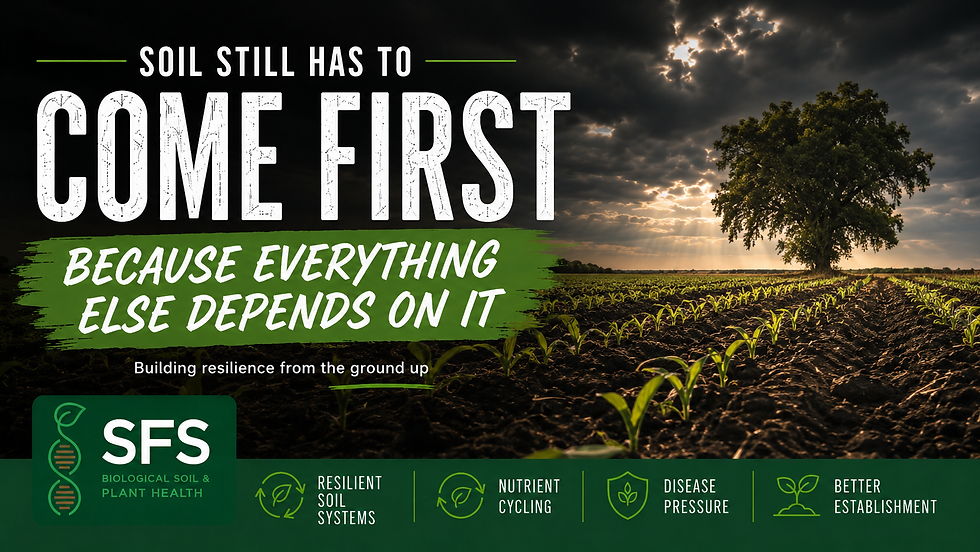
The weather gives us plenty to talk about, but the soil decides how much it really matters. What has been so striking is how differently fields have behaved. Some have absorbed the rain and drained quietly, others have shed water across the surface, carrying soil and nutrients into ditches and streams. In many areas, this has been evident, with muddy water crossing roads and filling drains with silt. It is simply a sign that some soils have had to give water up rather than take it in.
That difference is not about rainfall; it is about soil function and what protects the surface when rain arrives.
Where ground has been left bare over winter, the soil takes the full force of impact. Aggregates break down, pores seal, and infiltration slows. Where living roots are present, from crops or cover crops, the soil is better held together, channels remain open, and water is more likely to move downwards rather than sideways. Roots create pathways, residues soften impact, and biological activity continues for longer into the season.
When the structure is working, water moves through the profile, air returns more quickly, and nutrients are more likely to stay where crops can use them. When the structure is weak or compacted, water sits and runs, taking fine soil, carbon and fertiliser with it.
Every loss of soil is also a loss of future resilience. Carbon and biology leave the field, and the soil becomes less able to cope with the next heavy rainfall. Carbon is often discussed in the context of climate change, but in practical terms, its role is simple. It binds soil into stable aggregates and creates the pore spaces that allow water and air to move. Soils with carbon behave like sponges, but soils without it act more like worktops.
Resilience is not built in one season, and it is not created by one product. It comes from a system moving steadily in a different direction. Reducing disturbance, avoiding long periods of bare soil, keeping living roots in the ground and supporting biological processes all improve structure and water-holding capacity. These changes do not eliminate the need for inputs, but they reduce the system's dependence on them to fix problems after they appear. Systems that hold water, retain nutrients and keep roots functioning are naturally less reliant on repeated interventions to correct what has already gone wrong.
This is where SFS sits. We work to optimise soil and plant performance so farms become less dependent on artificial inputs and more resilient over time. That is not about swapping fertiliser for biology or chemistry for compost. It is about improving how nutrients cycle, how roots explore the soil and how the system responds under stress. Tools such as biological inputs, alongside measures to build carbon, can support that shift. Products like Humic SC, for example, are one option that can help stabilise carbon in the soil, support aggregation and improve how water and nutrients are held within the profile when used as part of a wider programme.
Rain will always be part of farming in the UK. In some years, it will arrive at the wrong time and in the wrong amount, and there is nothing we can do about that. What we can influence is whether our soils are ready for it.
We cannot change what has already been, but we can influence what is yet to come. The choices made this spring and summer will shape how fields respond to the next spell of heavy rain. Resilient soils do not prevent extreme weather, but they do stop it from causing lasting damage. The weather will keep testing our fields. The question is whether our soils are learning from it.
Feel free to share this blog post.
"Change does not begin with the weather. It begins with
what we decide to do next."
To learn more:
01366 384899
Bio-N supports nitrogen consistency.
Humic SCG soil conditioner and improver.
ActiV8-Bio improves soil function.
Bio-Mulch accelerates residue turnover.
Vita-Protect keeps the crop active under stress.
BetterGrass improves forage balance and soil–sward efficiency.
Mega-Fos tackles phosphorus efficiency and rooting.
Vitaplex V8 assists better functions.
Bio-K supports potassium reliability.


I have observed that the inference and documentation are presented in a fair and impartial manner. Interpretations remain cautious. The website may contain supplementary contextual resources that pertain to this issue. Digital entertainment ecosystems contextualize user pathways.