
Nutrient Balance: What the Farm Is Telling You (Whether You Ask or Not)

Most nutrient decisions are made field by field, crop by crop. That’s sensible. It’s how agronomy works on the ground, and it’s how most of us were trained to think. Rates, timing, placement. Make the crop work, then move on to the next field.
But farms don’t behave field by field. They behave as systems.
Nutrients don’t disappear because a rate was wrong. More often, they disappear because the system they’re moving through isn’t holding them as well as we think it is. A farm can be applying sensible rates, growing decent crops and still be quietly losing nitrogen, building phosphorus where it isn’t needed, or tying up potassium in ways that don’t show up until pressure arrives.
You don’t always see this in a single season. You see it over time. In soils that drift despite “doing the right things”. In responses that flatten out. In inputs that stop paying their way as reliably as they once did.
That’s where nutrient balance becomes useful — not as a rulebook, and not as a compliance exercise, but as a way of seeing the whole picture.
At its simplest, nutrient balance is just stepping back and asking a bigger question: what is coming onto the farm, and what is actually leaving it? It doesn’t replace field recommendations or soil analysis. It sits above them. It gives context to all the individual decisions being made underneath.
The important thing isn’t a single number. It’s the direction of travel. One year rarely tells you much. Patterns do.
When you start looking this way, a few things become clearer quite quickly. Nitrogen is inherently leaky. Phosphorus tends to accumulate. Potassium moves when structure and biology allow it to. You can be precise with fertiliser and still see losses. You can be careful with phosphorus and still see soil indices creep. None of that necessarily means something is being done “wrong”. It usually means the system isn’t working as efficiently as it could.
Traditional nutrient management focuses heavily on what to apply. Nutrient balance shifts the focus slightly, toward how efficiently the farm is using what it already has. Are nutrients being taken up when crops need them, or passing straight through? Are they cycling within the soil–plant system, or repeatedly being imported to replace what’s been lost?
Once you frame it like that, it becomes obvious that this isn’t just a chemistry issue. It’s a biological one.
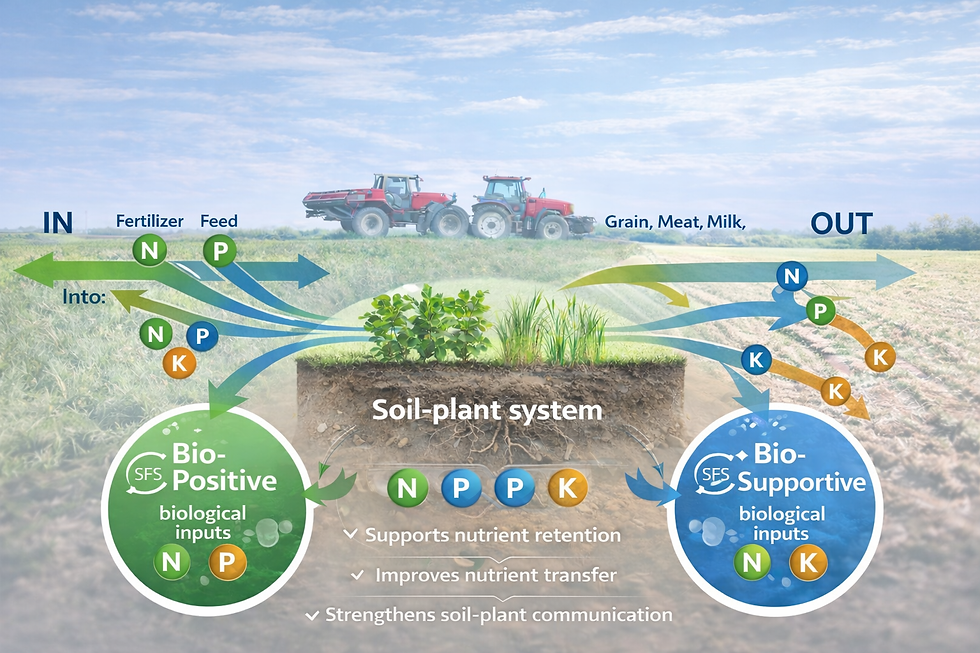
Roots, microbes, structure and carbon flow all influence how long nutrients stay productive. Biology doesn’t create nutrients out of thin air, but it changes their behaviour. It slows losses. It improves access. It helps nutrients do more work before they leave the system.
This is where we talk internally at SFS about Bio-Supportive and Bio-Positive thinking. Not as labels, and not as marketing terms, but as a way of describing how different inputs interact with the farm.
Bio-Supportive inputs help nutrients move and function more effectively. They support availability, ease stress and improve consistency. Bio-Positive inputs go a step further. They improve the system itself — supporting biology, aggregation and cycling — so a greater proportion of nutrients stay in the system doing useful work.
We don’t see these products as replacements for fertiliser, and we’re careful not to present them that way. They don’t force responses, and they don’t override good agronomy. What they do is help the system hold onto value. They make nutrients behave better. They make outcomes steadier, particularly when conditions aren’t ideal.
Over time, that shows up in quieter ways. Fewer surprises. More consistent responses. Nutrient balances that start to make sense rather than raising questions. Soils that become more forgiving instead of more demanding.
Nutrient balance, in that sense, isn’t about hitting a target or passing a test. It’s about understanding whether the system is working with you or quietly against you. When the system improves, decisions get easier, inputs work harder, and soils stop drifting in the wrong direction.
That’s what Bio-Positive farming is really about.
To learn more:
Bio-N supports nitrogen consistency.
ActiV8-Bio improves soil function.


Comments