
Nitrogen doesn’t fix a tired crop; it only tells it to grow


Let’s be honest. Growing a crop has never felt cheap. By ‘cheap,’ I mean it always seems to cost more than you’d like, relative to the return you’re hoping for. Nitrogen has always dominated that equation, and it still does.
But this season, cutting back isn’t the answer.
Optimising what you’re already doing is.
Across the farming forums, you can see the same pattern every year: growers itching to get nitrogen on. Often, those decisions are driven more by calendar and habit than by what the crop and soil are actually experiencing.
And so far, 2026 hasn’t exactly set crops up kindly.
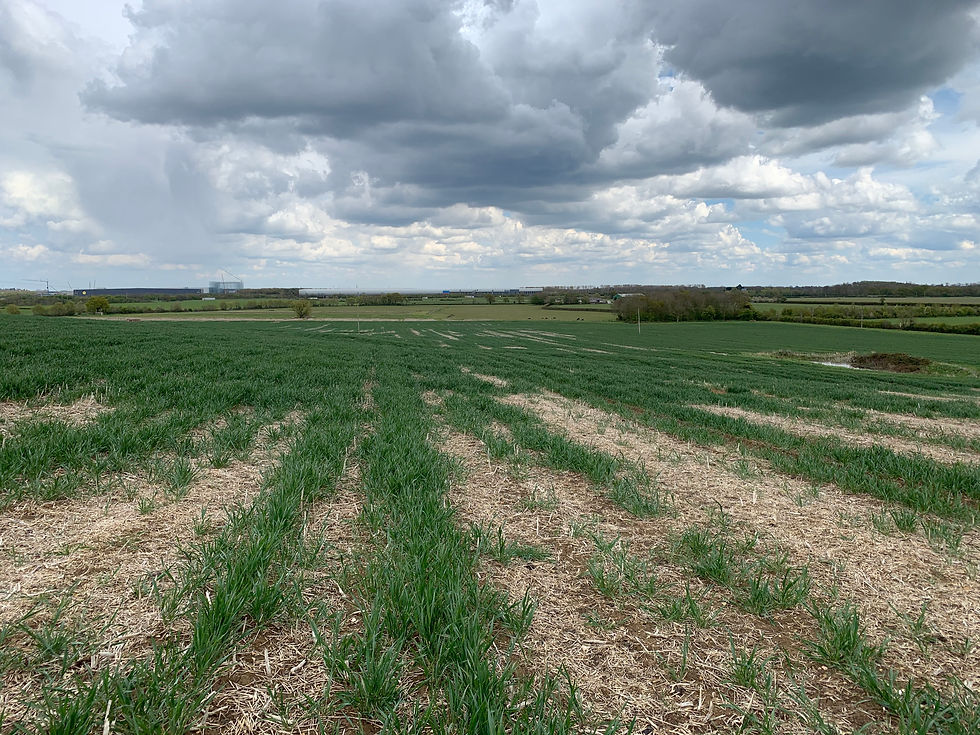
Winter cereals and grassland alike have spent long periods under wet, cold soil conditions. When soils stay saturated, roots run short of oxygen and soil biology slows or retreats. Crops emerge from winter with reduced root function and limited access to nutrients that are technically present but biologically unavailable.
So potential is already constrained before spring even starts.
The instinctive response is nitrogen, because nitrogen can kick-start growth.
But nitrogen doesn’t build a functioning plant on its own.
A crop doesn’t just need stimulus. It needs support.
Think of it like being woken abruptly by a very strong cup of coffee. It will get you going, you might even feel sharp for a while. But if you skip breakfast and proper nutrition, that caffeine surge fades quickly and leaves you worse off. Another coffee might carry you further, but sooner or later the body needs real nourishment.
Early-season nitrogen can behave exactly the same way.
Applied N tells the canopy to move. Light levels are rising and growth is triggered, but soil temperature is still low and biology remains slow. Roots, often compromised by winter, have limited access to phosphorus and trace support. You end up with a plant being pushed to grow above ground while the root system quietly says “bugger off”.
Same problem, different year. It’s something I see most springs on heavier or colder soils.
That’s exactly the gap we’ve been trying to bridge with early-season biological phosphate support. In SFS programmes, that role sits with Mega-Fos.
Where nitrogen stimulates growth, Mega-Fos supports the soil–plant system that has to sustain it. Spray applied to the crop from mid-March onwards, it promotes phosphate mobilisation, root elongation and early plant health at a point in the season when soils are still biologically sluggish.
In simple terms, nitrogen starts the engine.
Mega-Fos ensures the plant has the functional root system to keep running.
Field use and trials have shown that following early nitrogen with Mega-Fos improves both yield and margin. Not because it replaces fertiliser, but because it improves the efficiency with which that fertiliser is used, protecting the biggest investment already made.
If nitrogen is the coffee, Mega-Fos is the full English breakfast that lets it actually work.
The formulation combines targeted microbes with cavitated worm-compost extract and trace elements. Together they stimulate phosphate release, support root extension and strengthen early plant resilience. In effect, a defending army on both root and leaf, working together to support the crop and the soil it grows in.
If early nitrogen efficiency, phosphate availability and root optimisation matter on your farm this spring, Mega-Fos is the tool I use for exactly that window.
There are also Mega-Fos options suited to organic and vegetable systems, so the same early-season phosphate and root support approach can be applied across rotations.
Typical use sits around 10 L/ha, roughly £20/ha, applied as crops move into active spring growth:
Winter wheat, around GS30
Winter barley, around GS25
Winter oilseed rape, mid-March
Rye, mid-March
Beans, pre-flowering
Grassland, mid-March
The principle is consistent across all of them. As soon as the crop is asked to grow but the soils are still cold and biology is lagging, that’s when phosphate support pays.
To learn more:
01366 384899
Bio-N supports nitrogen consistency.
Humic SCG soil conditioner and improver.
ActiV8-Bio improves soil function.
Bio-Mulch accelerates residue turnover.
Vita-Protect keeps the crop active under stress.
BetterGrass improves forage balance and soil–sward efficiency.
Mega-Fos tackles phosphorus efficiency and rooting.
Vitaplex V8 assists better functions.
Bio-K supports potassium reliability.


Comments