
Cereals 2026 at Diddly Squat: From Top Gear to Wet Gear

Cereals 2026 at Diddly Squat Farm was never going to be an ordinary farming event.
Put one of the UK’s biggest crop shows on the farm made famous by Jeremy Clarkson, Clarkson’s Farm, the Diddly Squat Farm Shop and The Farmer’s Dog, and the audience was always going to stretch a bit further than the usual Cereals crowd. Part crop event, part agricultural show, part Clarkson pilgrimage, and, by Thursday, part practical assessment of waterproof clothing.
The waterproof clothing was optimistic.

There had already been a bit of Diddly Squat feedback before the event even started. Back in the spring, Charlie Ireland, Clarkson’s Ceres Rural adviser, had apparently seen our SFS sign made from stones and commented that the farm did not need any more stones than it already had. That was fair enough, and it did mean there was one job after the show that nobody was going to forget.

Take the stones home.
Apparently, Diddly Squat already has sufficient reserves.
As usual, there were queues to get in. It would not be Cereals without sitting in traffic long enough to start wondering whether crop nutrition could have been discussed perfectly well by email. But once people were through the gate, the event had a good feel to it. Busy, slightly chaotic, very agricultural, and full of people who had clearly come to look, question, compare and, in some cases, find out whether Diddly Squat came with mud included. It did.
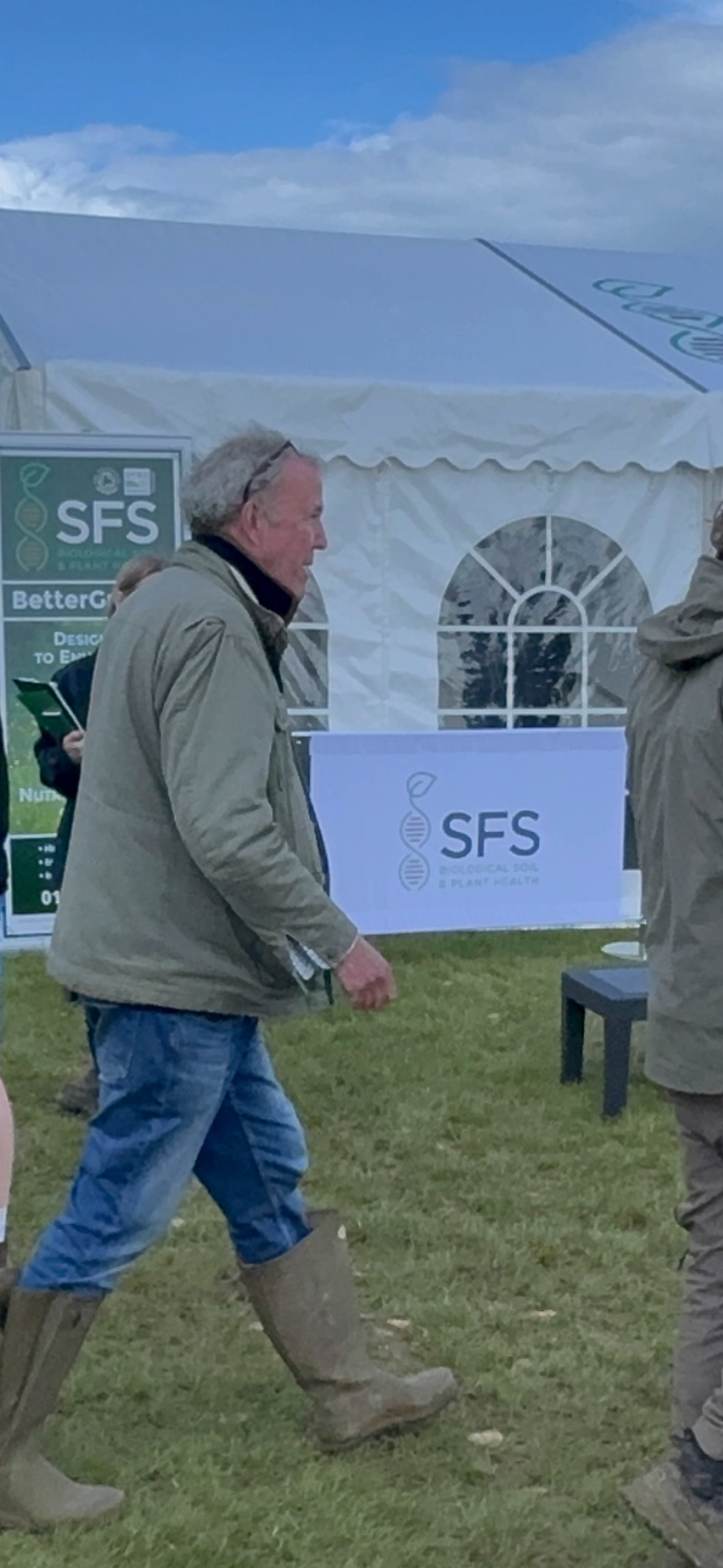
The Clarkson link was always going to be hard to ignore, especially when the man himself came past the SFS stand while making his way around the show. I asked him for a selfie. He replied and said he does not do selfies, which was fair enough. He has, of course, been photographed with James May, Richard Hammond and Kaleb Cooper, so clearly standards can be flexible. Given that I am at least as photogenic as two of them, I can only assume it was his loss.
I was also slightly disappointed that he walked past without noticing our V8 product, considering the motoring connection. This is, after all, a man with a long and public appreciation of big engines, loud noises, shiny cars and fuel economy best described as theoretical.
You would think something called V8 might have earned at least half a glance. Apparently not.
Perhaps next year we need to polish the label and make it idle noisily.
By Thursday afternoon, the weather had become the main exhibitor. I had made the sensible

decision to stay as dry as possible, but the rain had clearly made other arrangements. After a while, you stop trying to remain dry and simply accept that you have become part of the site drainage. My coat, it turned out, was less waterproof and more hopeful.
In a strange way, the weather probably suited Cereals. Nobody wants to stand in a wet field, but it does stop the whole thing feeling too polished. By the afternoon, the plots, the boots and the visitors had all been tested. Some had coped better than others.
That was the useful part of the show.
We spoke to plenty of existing customers, but also to a lot of growers who were new to SFS. Some knew the name, some had seen the plots, some wanted to talk about cost, and some were simply curious enough to come over and ask what we were doing.
We were also giving away SFS thermos mugs and notebooks, so it would be dishonest to pretend every visitor was pulled in by a sudden urge to discuss nutrient efficiency. In my experience, freebies have always been a respectable part of agricultural engagement.
What stood out this year was the quality of the questions. Less “is this serious?” and more “where does it fit, what does it cost, what is the risk, and what does it leave behind when the figures are done?”
That was the shift.
Our trial plots helped because they gave people something to look at while asking those questions. Cost was one of the main talking points, as it usually is when theory has to stop being charming and start earning its keep. A cheaper programme is only useful if the crop still performs. An expensive programme is only clever if it pays for the privilege.

Standing in front of the plots made the discussion more useful. It was not just products, claims or opinions. It was crop condition, input spend, and the slightly awkward business of comparing what we thought might happen with what was actually standing in the field.
The final judgement still depends on yield. We have taken a square metre sample from each plot to estimate final yield, and those results will follow. Early signs are good, but crops have a long tradition of embarrassing people who celebrate before the combine has finished.
Rust came into the conversation as well, although at a Clarkson-linked event it was worth being clear that we were talking about wheat, not something quietly spreading along the wheel arch of an old Alfa Romeo.

It was easy enough to find around the show, and some plots were clearly under pressure. A few people commented that our crop plots looked surprisingly clean, especially once they realised that some had received reduced fungicide applications and others had received none at all. That does not prove everything, of course.
It proves that people at field events will always look harder once they suspect there may be a catch.
But it was useful, because the conversation moved away from what had been applied on paper and towards what people were actually seeing in the crop.
Grass came into it too, especially around feed value and mineral status.
That was encouraging, because grass can look very green while quietly failing to be as useful as it should be. The better question is not just whether it grew, but what it grew into, and whether it is worth anything when it reaches the animal.
That, for me, was the real feel of Cereals this year.
The Clarkson effect clearly brought attention to the event and probably carried Cereals further beyond the usual farming audience than it might otherwise have. That has to be a good thing. Farming does not often get that sort of wider public interest, even if some of it arrives because people want to see Diddly Squat rather than discuss crop inputs in the rain.
For us, that wider reach matters.
SFS has spent years working in soil health, crop function, input efficiency and plant health. We know these ideas only move forward when people see the work, ask questions and look at what is actually happening in the field.
So if Cereals at Diddly Squat helped a few more people notice us who wouldn’t normally have found us, then the traffic, the rain, the mud, and the rejected selfie were probably worth it.
We even remembered to take the stones home.
Still no selfie required.
Steve Holloway
Technical Manager


Comments